The Sun Wants to Kill Mars Astronauts — And We're Not Ready to Stop It
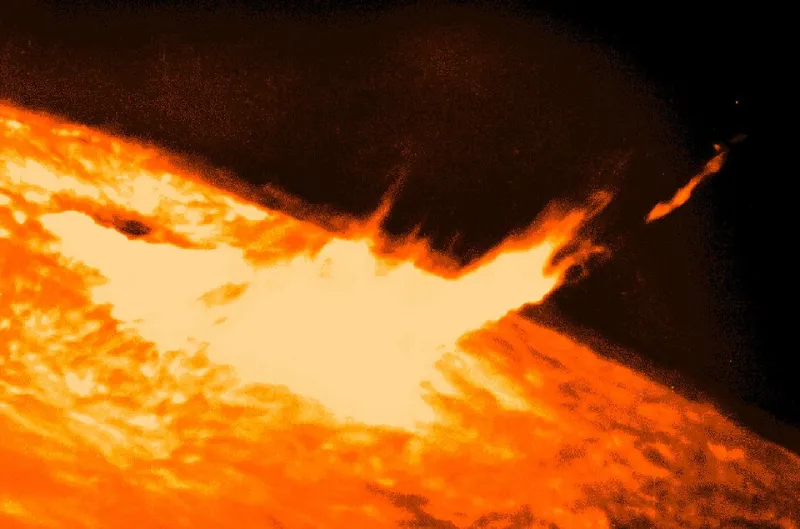
Photo: NOIRLab, CC BY 4.0, via Wikimedia Commons
Everybody loves talking about the rockets. The timelines, the landing systems, the drama of Starship tests lighting up social media — that's the stuff that fills feeds and sells tickets to the public imagination. But ask a radiation physicist what keeps them up at night about sending humans to Mars, and you'll get a very different conversation. One that's quieter, more technical, and honestly a lot scarier.
Solar particle events — sudden eruptions of high-energy protons blasted out from the sun's surface — are one of the least-discussed threats facing any crewed Mars mission. And the gap between how serious scientists consider this problem and how little it penetrates public awareness is, frankly, stunning.
What a Solar Storm Actually Does to a Human Body
Here on Earth, we're wrapped in a magnetic field that deflects most of the sun's worst output. Even on the International Space Station, astronauts receive elevated radiation doses but remain within ranges that NASA considers manageable for six-month tours. Mars is a completely different story.
Mars has no global magnetic field worth mentioning. Its atmosphere is roughly 1% as thick as Earth's. That means the surface of Mars sits almost entirely exposed to whatever the sun decides to throw at it. During a quiet period, radiation on Mars runs about 40 to 50 times higher than what you'd experience on Earth's surface. During a major solar particle event — the kind that happens without much warning — doses can spike dramatically within hours.
High-energy protons don't just pass through you harmlessly. They damage DNA, disrupt cell replication, and over time significantly elevate cancer risk. A single large solar storm could, depending on the shielding available, expose an astronaut to a dose equivalent to hundreds of chest X-rays in the span of a day or two. The long-term mission to Mars, factoring in the six-to-nine-month transit each way plus surface time, could push cumulative doses well beyond current NASA career limits.
What the Data From Our Rovers Actually Shows
This isn't theoretical hand-wringing. We have real numbers. The Curiosity rover carries a radiation detector called the Radiation Assessment Detector, or RAD, which has been logging data from the Martian surface since 2012. What RAD found confirmed what physicists feared: radiation on Mars is relentless.
During the transit to Mars alone — before Curiosity even landed — RAD measured dose rates that would challenge human health on a round trip. On the surface, the data showed that a hypothetical astronaut spending 500 days on Mars would absorb roughly 300 millisieverts of radiation, just from baseline galactic cosmic rays. Throw in a significant solar particle event, and that number climbs fast.
To put that in American context: the average US resident absorbs about 3 millisieverts per year from natural background radiation. NASA's current career limit for astronauts is set to keep lifetime cancer risk increases below 3%. A Mars mission, under current shielding assumptions, blows through that budget uncomfortably fast.
Why This Doesn't Get the Headlines It Deserves
Part of the problem is that radiation is invisible and slow-acting. It doesn't make for dramatic footage. You can't photograph a sievert. Compare that to the spectacle of a rocket launch or the romance of a dusty Martian landscape, and it's easy to see why radiation gets buried in technical appendices rather than splashed across news sites.
There's also an institutional tendency to treat unsolved problems as details to be worked out rather than obstacles worth flagging loudly. Nobody building hype around a Mars mission wants to lead with "by the way, we don't have the shielding figured out yet."
But NASA's own documentation doesn't hide the concern. The agency has consistently listed space radiation as one of the five major human research risks for deep space exploration, alongside isolation, distance from Earth, hostile closed environments, and gravity fields. It's sitting right there in the literature — it just rarely makes the jump to mainstream coverage.
What Engineers Are Actually Working On
To be fair, the scientific community isn't sitting still on this. Several approaches are being explored, each with real promise and real limitations.
Polyethylene-based shielding has gotten attention because hydrogen-rich materials are better at breaking up high-energy particles than traditional aluminum spacecraft walls. Some researchers are looking at water walls — essentially lining crew quarters with water-filled panels — which would double as radiation shielding and a supply reserve. Practical, but heavy, and mass is everything in spaceflight.
Storm shelters are another concept: a small, heavily shielded compartment inside the spacecraft or habitat where the crew retreats when sensors detect an incoming solar event. The challenge is warning time. Solar particle events can arrive with as little as 15 to 30 minutes of notice after detection, so real-time monitoring systems need to be reliable and fast.
Pharmaceutical countermeasures are being studied too — drugs that might reduce the cellular damage caused by radiation exposure. Some compounds have shown promise in lab settings, but moving from mouse studies to human-safe treatments ready for a Mars mission is a long road.
Electromagnetic shielding — essentially creating an artificial magnetic bubble around a spacecraft or habitat — sounds like science fiction but has serious engineering teams working on it. The power requirements are currently prohibitive, but miniaturization and advances in superconducting materials could change the math over the next decade.
The Policy Question Nobody's Asking Loudly Enough
Here's where this stops being just a science story and becomes a policy story. NASA's current career dose limits were designed for low-Earth orbit operations. They weren't built with a 900-day Mars mission in mind. The agency has been wrestling internally with whether to revise those limits — essentially accepting higher risk — or to make solving the radiation problem a hard prerequisite before any crewed mission gets a green light.
That's not a technical decision. That's an ethical one. And it's the kind of decision that deserves public debate, congressional scrutiny, and honest communication with the astronauts who'd be volunteering to accept that risk.
Private players like SpaceX operate under different frameworks. They're not bound by NASA's career limits in the same way, and their public timelines for crewed Mars missions don't always come with detailed radiation mitigation plans attached. That gap between ambition and safety infrastructure should be getting more attention than it currently is.
What You Can Do With This Information
If you're a space enthusiast — and if you're reading Marspedia, you almost certainly are — understanding the radiation challenge is part of being a genuinely informed advocate for Mars exploration. The mission deserves supporters who ask hard questions, not just cheerleaders.
Follow the RAD data. Read the NASA Human Research Program publications. When you see a crewed Mars timeline announced, ask what the radiation mitigation plan looks like. Push for coverage that goes beyond the rockets.
The path to Mars runs straight through this problem. The sooner it gets the attention it deserves, the sooner we actually solve it.