Why Mars Conspiracy Theories Keep Going Viral — And What You Can Do About It
Scroll through any Mars-related hashtag on a slow Tuesday night and you'll find it: grainy rover footage captioned with breathless claims about ancient cities, blurry rock formations labeled as alien skulls, and comment threads full of people insisting NASA is hiding the "real" Mars from the public. It's exhausting — and it's everywhere.
America has a complicated relationship with space agencies, government transparency, and scientific authority. That cocktail, mixed with the algorithmic chaos of social media, has turned Mars into one of the most fertile grounds for pseudoscience on the internet. Understanding why this keeps happening is the first step toward actually doing something about it.
The Psychology of a Good Mars Myth
Here's the uncomfortable truth: conspiracy theories about Mars aren't popular because people are gullible. They're popular because they tap into something deeply human — the desire for discovery, the thrill of forbidden knowledge, and a healthy (if sometimes misdirected) skepticism of powerful institutions.
Mars is uniquely positioned to feed all of that. It's close enough to feel real, distant enough to remain mysterious, and actively explored by a government agency that — let's be honest — has a historically patchy record of public communication. When NASA delays a press release or uses carefully hedged language about a scientific finding, that ambiguity gets filled in fast by people with a very different interpretation.
Psychologists call this "proportionality bias" — the assumption that big, dramatic events must have big, dramatic explanations. Finding microbial fossils on Mars? Cool. Finding out NASA knew about a Martian civilization for decades and kept it quiet? That's a story worth sharing. Never mind that one of those things is supported by evidence and the other isn't.
The Greatest Hits of Mars Misinformation
Some false claims about Mars have been circulating so long they've practically become folklore. A quick rundown of the greatest offenders:
The Face on Mars. This one's a classic. A 1976 Viking 1 photo showed a mesa in the Cydonia region that, at low resolution, vaguely resembled a human face. Decades of follow-up imaging — including high-resolution shots from Mars Global Surveyor — showed it's just a hill. Still, the "Face" gets resurrected every few years with fresh urgency.
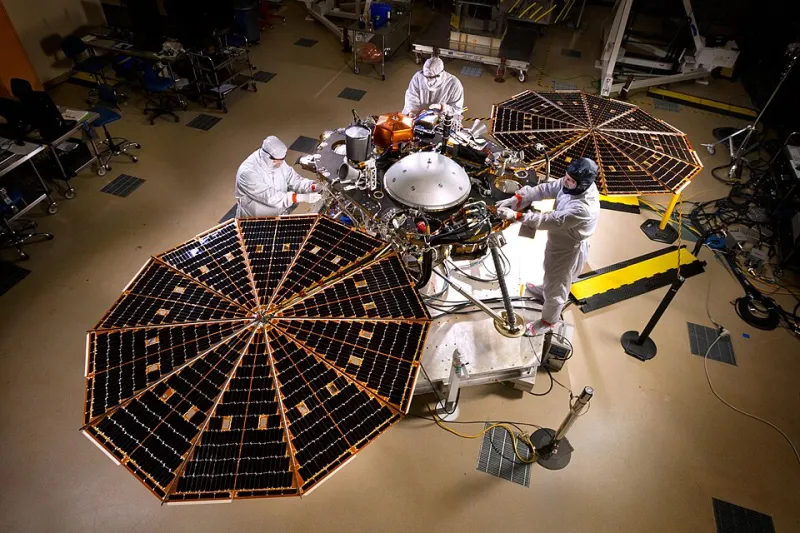
The hollow planet theory. A fringe claim suggesting Mars is artificially hollow, sometimes with an interior civilization. There is zero geological or seismic evidence for this. The InSight lander spent years listening to marsquakes and gave us detailed data on the planet's interior structure. Spoiler: it's layers of rock and a liquid iron core, same as every other rocky planet.
The NASA coverup of liquid water (or life). This one mutates constantly. In reality, NASA has been extremely public about water-related discoveries on Mars — from subsurface ice to ancient riverbeds to possible brine flows. The agency literally held press conferences about it. The "coverup" version of events requires ignoring a library's worth of open-access research.
The "they're already there" theory. A persistent claim that secret human missions to Mars have already happened, usually tied to defense contractors or shadow government programs. No credible whistleblower, no leaked documentation, no verifiable evidence has ever supported this.
Why American Audiences Are Especially Susceptible
This isn't about intelligence — it's about context. The United States has a specific cultural history with government secrecy: the Tuskegee experiments, MK-Ultra, the Gulf of Tonkin incident, mass surveillance revealed by Snowden. Americans have real, documented reasons to sometimes distrust official narratives.
Add to that a media ecosystem that rewards engagement over accuracy, a science education system that inconsistently teaches critical thinking, and a political climate where "doing your own research" has become a badge of honor, and you've got ideal conditions for misinformation to thrive.
Mars content also benefits from what researchers call the "third-person effect" — people tend to think other people are more susceptible to false claims than they are. So someone might share a sketchy Mars video thinking they're just being open-minded, not realizing they're amplifying misinformation to their entire network.
Real Science Moves Slowly. Algorithms Don't.
Here's where the structural problem really bites. A peer-reviewed paper about Mars geology takes years to produce, goes through multiple rounds of expert review, and gets published in a journal most people have never heard of. A YouTube video claiming NASA is covering up Martian ruins takes an afternoon to make and can rack up a million views in 48 hours.
The platforms where most Americans encounter Mars news — YouTube, TikTok, X (formerly Twitter), Facebook — are optimized for engagement, not accuracy. Outrage and wonder perform better than nuance. A headline that says "Scientists Find More Evidence Mars Once Had Liquid Water" will always lose clicks to "NASA Hides Proof of Ancient Mars Civilization."
This isn't a new problem, but it's gotten dramatically worse as short-form video has made it even easier to strip scientific findings of their context.
How to Actually Push Back
If you're a space enthusiast who's tired of watching bad Mars takes go viral, here are some concrete moves:
Get comfortable with primary sources. NASA's Mars Exploration website, the JPL mission pages, and NASA's Scientific and Technical Information portal are all publicly accessible. When a wild claim surfaces, check whether the underlying mission data actually supports it before sharing anything.
Learn what peer review looks like. Not every science-adjacent website is equal. Publications like Icarus, Journal of Geophysical Research: Planets, and Nature Geoscience are where real Mars research lands. Google Scholar makes it easy to search for free.
Ask the right questions. When you see a Mars claim online, run through a quick checklist: Who made this claim? What's their background? What evidence do they cite? Has anyone with relevant expertise reviewed it? Does the claim require a massive, unprecedented conspiracy to be true?
Engage without being condescending. The worst thing you can do when someone shares a Mars conspiracy is mock them publicly. Research consistently shows that shaming people makes them dig in harder. A genuine question — "Hey, I looked into this, here's what the actual mission data shows" — lands better than ridicule.
Support good science communication. Follow planetary scientists on social media. Share quality Mars content from sources like the Planetary Society, JPL's official channels, and yes, places like Marspedia that work to make real science accessible and interesting. Every share is a small vote for accuracy.
The Stakes Are Higher Than You Think
Mars misinformation isn't just a harmless quirk of internet culture. As real Mars missions ramp up — from NASA's Mars Sample Return program to private ventures eyeing crewed missions — public understanding of what Mars actually is will matter enormously. Policy decisions, funding priorities, and even international cooperation on space exploration all get shaped, at least in part, by what the American public believes about the Red Planet.
When false narratives crowd out accurate ones, it doesn't just make online conversations worse. It erodes the informed public engagement that ambitious space programs genuinely need to survive politically and financially.
The good news? The real Mars is strange and extraordinary enough to compete with any conspiracy theory. Ancient megafloods. Dust devils taller than Everest. A sky that turns from blue at sunrise to pink by midday. You don't need to make anything up — you just need to know where to look.
And that's exactly what we're here for.