The Day Mars Lost Its Sky: How a Dead Magnetic Field Doomed a World—and What That Means for the Humans Heading There
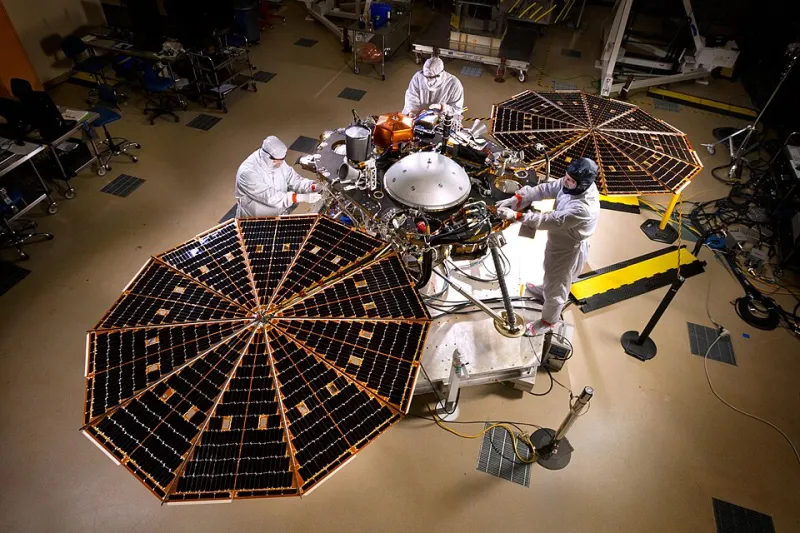
Photo: NASA/JPL-Caltech/Lockheed Martin, CC, via Wikimedia Commons
If you've ever held a compass and watched the needle swing north, you've felt the quiet power of Earth's magnetic field at work. It's invisible, it's easy to take for granted, and it is—without exaggeration—one of the main reasons you're alive right now. Earth's magnetosphere deflects a constant stream of charged particles blasting out from the Sun, keeping our atmosphere intact and our DNA relatively unscrambled.
Mars never got that lucky. Or more precisely, Mars had that luck once—and then lost it. What happened next reshaped an entire planet, and it's the kind of story that every serious Mars enthusiast needs to understand before daydreaming too hard about red-soil colonies and pressurized domes.
What Mars Used to Look Like
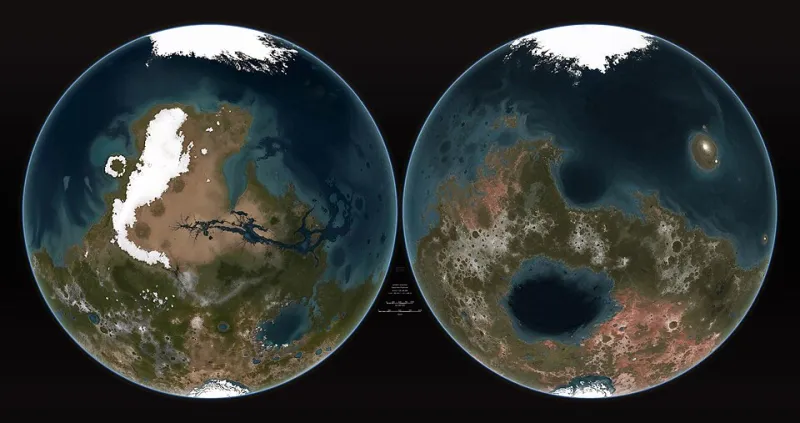
About 4 billion years ago, Mars was a genuinely different place. Scientists analyzing data from missions like MAVEN (Mars Atmosphere and Volatile EvolutioN) and the Mars Reconnaissance Orbiter have pieced together a picture of an early Mars that hosted a denser atmosphere, surface temperatures that may have occasionally supported liquid water, and—crucially—a functioning global magnetic field generated by a churning molten iron core.
That magnetic field acted exactly like Earth's does today: it formed a protective bubble around the planet, forcing the solar wind to flow around Mars rather than slam directly into its upper atmosphere. Ancient Mars, in other words, had a fighting chance.
The Core Goes Cold
So what happened? The short answer is that Mars is small—about half the diameter of Earth—and small rocky planets lose their internal heat faster. A planet's magnetic field is generated by convection currents in a liquid metallic core, a process called the geodynamo. When that core cools and solidifies, the dynamo shuts down.
Research published in the last decade, including analysis from NASA's InSight lander (which measured Martian seismic activity until late 2022), has helped scientists refine the timeline. Mars's geodynamo appears to have weakened and ultimately collapsed somewhere between 3.7 and 4.1 billion years ago. Some studies suggest the process may have been patchy at first—remnant magnetic signatures preserved in ancient crustal rocks in the southern highlands hint that the field may have flickered before going dark entirely.
Once that protective bubble collapsed, Mars was fully exposed.
The Solar Wind Does Its Work
Here's where things get brutal. The solar wind isn't just a gentle cosmic breeze—it's a continuous stream of energetic protons and electrons traveling at hundreds of miles per second. Without a magnetic field to redirect that flow, those particles began hammering Mars's upper atmosphere directly.
The process is called atmospheric sputtering and ion escape, and the MAVEN mission has given us the best real-time look at it ever captured. Scientists have measured Mars losing roughly 100 grams of atmosphere per second even today, billions of years after the worst of the stripping occurred. During solar storms, that rate spikes dramatically. Over geological timescales, the math adds up to catastrophic loss.
The result? Mars went from a world with atmospheric pressure potentially comparable to early Earth's to its current state: an atmosphere about 1% as dense as ours, composed mostly of carbon dioxide, with surface pressures so low that liquid water simply can't exist on the surface. The climate collapsed. Temperatures swung to extremes. Whatever water hadn't escaped into space froze into the polar ice caps or went underground.
What This Actually Means for Future Colonists
This is where the history lesson becomes a very practical engineering problem—and why the topic deserves serious attention in any honest conversation about Mars settlement.
Radiation is the big one. Without a magnetic shield, the Martian surface receives far higher doses of galactic cosmic rays and solar energetic particles than Earth does. NASA's Curiosity rover measured radiation levels on the Martian surface and found that a person standing there would absorb roughly 0.67 millisieverts per day just from background radiation—before any solar storm events. For context, the annual radiation limit for U.S. radiation workers is 50 millisieverts. Do the math and it's clear that long-term surface exposure is a genuine health threat, raising cancer risks and potentially damaging the central nervous system.
Short of re-magnetizing an entire planet (which is firmly in science fiction territory for now), the solutions being discussed fall into a few categories:
- Underground habitats. A few meters of Martian regolith provides meaningful shielding. Many serious Mars architecture proposals lean heavily on subsurface or bermed structures for this reason.
- Water walls. Water is an excellent radiation absorber. Some habitat concepts incorporate water storage in the walls of living spaces, serving double duty.
- Artificial magnetic shields. This sounds wild, but NASA scientists have actually floated the idea of placing a large magnetic dipole shield at the Mars L1 Lagrange point—essentially parking a giant electromagnet between Mars and the Sun to deflect the solar wind before it reaches the planet. It wouldn't fully replicate a planetary magnetosphere, but modeling suggests it could meaningfully reduce atmospheric loss and surface radiation.
- Pharmaceutical and genetic approaches. Longer-term, some researchers are looking at radiation-hardening strategies for human biology, including drug interventions and even theoretical gene editing. These are speculative, but they're on the table.
Atmospheric pressure is the second challenge. Even if we establish a sealed habitat tomorrow, the thin Martian atmosphere means that any large-scale terraforming effort faces an uphill battle. Without a magnetic field, any atmosphere we tried to build up would continue eroding away—just more slowly than the original loss. Some scientists argue this makes full terraforming essentially impossible on human timescales. Others think the erosion rate is manageable enough that a thickened atmosphere could persist for thousands of years, buying time for future civilizations.
Why Understanding This Makes You a Better Mars Advocate
One thing that separates casual space fans from people who are genuinely engaged with Mars exploration is understanding the constraints. It's easy to get swept up in the romance of a red-soil colony or the drama of a crewed landing. But the magnetic field story is a reminder that Mars isn't just a slightly inconvenient version of Earth—it's a fundamentally different kind of place, shaped by a planetary-scale catastrophe that happened before complex life even existed on our own world.
That doesn't make Mars less worth going to. If anything, it makes the scientific and engineering challenges more compelling. The people working on Mars habitat design, radiation shielding protocols, and atmospheric science aren't just solving abstract problems—they're responding to a 4-billion-year-old disaster and trying to figure out how human ingenuity can work around it.
For those of us following along from Earth, understanding the magnetic field story gives every rover image, every atmospheric measurement, and every habitat concept a richer context. Mars isn't empty because nothing interesting happened there. It's empty because something catastrophic did—and the evidence is written in the rocks, the thin cold air, and the relentless radiation bathing the surface right now.
That's a story worth knowing. And if you're serious about Mars, it's one you'll want to keep following closely as the next generation of missions and human exploration plans take shape.