What's in a Mars Name? The Surprisingly Political History of How We Label the Red Planet
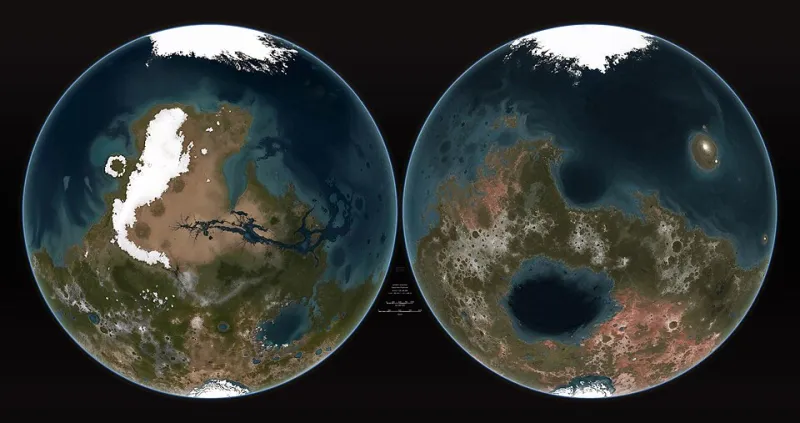
Photo: Pablo Carlos Budassi, CC BY-SA 4.0, via Wikimedia Commons
Next time you read a headline about the Jezero Crater or the Elysium Planitia, pause for a second. Those aren't random syllables pulled from a hat. Every crater, canyon, rover, and mission tied to Mars carries a name with a story behind it — sometimes a deeply human one. And when you start pulling that thread, you quickly realize that naming things on Mars is one of the more quietly fascinating intersections of science, culture, and yes, politics in all of space exploration.
So let's dig in.
The Rule Book Nobody Talks About
There's actually a governing body for this stuff. The International Astronomical Union — the IAU — has been the official referee of planetary nomenclature since 1919. Think of them as the Supreme Court of space names. They maintain strict thematic rules for each planet and moon, and Mars has one of the more elaborate systems in the solar system.
The general framework goes like this: large Martian valleys (called valles) are named after the word for Mars or "star" in various world languages. Plains (planitiae) get names from classical mythology. Craters smaller than 60 kilometers? Those are typically named after small towns and villages on Earth — which is why you've got craters named after places like Gusev (a town in Russia) and Holden (a village in Missouri, among others).
Larger craters get the names of deceased scientists and writers who made significant contributions to the study of Mars. So when you see "Huygens Crater" on a map, that's a nod to the 17th-century Dutch astronomer Christiaan Huygens, who made early telescopic observations of the planet. It's a subtle way of building a hall of fame directly into the Martian landscape.
Mythology All the Way Down
Before modern planetary science formalized all these rules, early astronomers were working entirely from the classical playbook. Mars itself is named after the Roman god of war — a tradition that traces back thousands of years, when the planet's red color reminded ancient observers of blood and battle. That mythology never really went away.
Elysium, one of the major volcanic regions on Mars, takes its name from the Elysian Fields — the paradise of Greek mythology where heroes went after death. Olympus Mons, the largest volcano in the solar system, borrows from Mount Olympus, home of the Greek gods. Valles Marineris, the enormous canyon system that would swallow the Grand Canyon like a parking lot, was named after the Mariner 9 spacecraft that first imaged it in detail back in 1971.
There's a kind of poetry in that layering — ancient mythology sitting right next to mid-century spacecraft technology, all stitched together across the surface of another world.
When NASA Gets to Choose: Rovers and Missions
Here's where things get more culturally interesting. While the IAU controls surface feature names, NASA has considerably more creative latitude when it comes to naming its own missions and rovers. And those choices reveal a lot about what the agency — and the American public — wants to project about Mars exploration.
Consider the rover names. Sojourner, the first Mars rover deployed in 1997, was named after Sojourner Truth, the abolitionist and civil rights icon. A schoolkid from Connecticut named Valerie Ambroise won the naming contest, submitting an essay that argued the rover represented the spirit of discovery and truth. It was a genuinely moving choice that connected space exploration to American history in an unexpected way.
Spirit and Opportunity, the twin rovers launched in 2003, came from a NASA essay contest open to students across the country. A nine-year-old girl named Sofi Collis, who had been born in Siberia and adopted by an American family from Arizona, submitted the winning entry. Her essay talked about how America had given her both spirit and opportunity — and suddenly two robots on another planet became a story about immigration and belonging.
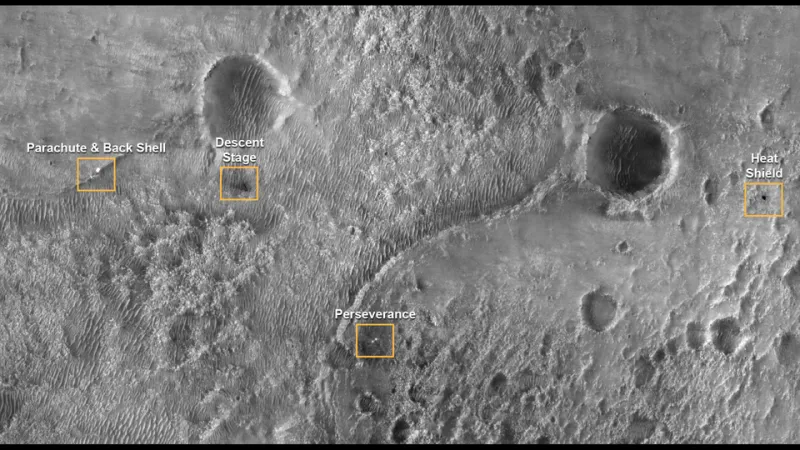
Then came Curiosity — selected through a public vote and essay contest, chosen from over 9,000 entries. And most recently, Perseverance, named by a seventh-grader from Virginia named Alexander Mather, whose essay argued that the defining human trait needed for Mars exploration was the willingness to keep going no matter what. Given everything that happened in 2020, when the rover launched, that name landed differently than anyone expected.
The Politics Beneath the Surface
It would be naive to pretend that naming is purely poetic. There's a geopolitical dimension here that doesn't always make it into the press releases.
The IAU's thematic rules — which pull names from dozens of different world languages and cultural traditions — were partly designed to prevent any one nation from planting its cultural flag all over the solar system. You won't find a crater named after an American president on Mars, for instance. That's intentional. Space, at least officially, is supposed to belong to everyone.
But the rover naming contests are a different story. Those are distinctly American exercises, and they function as soft power as much as science outreach. When a NASA rover lands on Mars with a name chosen by a U.S. schoolchild, it sends a message about who's driving this era of exploration. China's Zhurong rover, which landed in 2021, takes its name from a Chinese fire god — a similarly deliberate cultural statement.
As more nations and private companies develop Mars ambitions, the naming landscape is going to get considerably more complicated. SpaceX hasn't landed anything on Mars yet, but when it does, you can bet Elon Musk won't be calling up the IAU for permission to name the landing site.
Why Any of This Matters to the Rest of Us
You might be wondering why a naming convention deep-dive belongs on a site like Marspedia. Fair question. Here's the honest answer: the names we give Mars are part of how we make it real to ourselves.
When you look through a backyard telescope at that small reddish dot and know that somewhere on its surface there's a place called Jezero — a Bosnian word for lake, chosen because scientists believe it once held water — that name does something. It collapses the distance. It makes Mars a place with geography, with history, with meaning, rather than just a point of light.
For amateur astronomers, space enthusiasts, and anyone who's ever stayed up late watching a rocket launch with their heart in their throat, the names are part of the story. They're how a distant world becomes somewhere we're actually trying to go.
And the next time someone asks you why Olympus Mons is called Olympus Mons, you'll have a genuinely good answer.