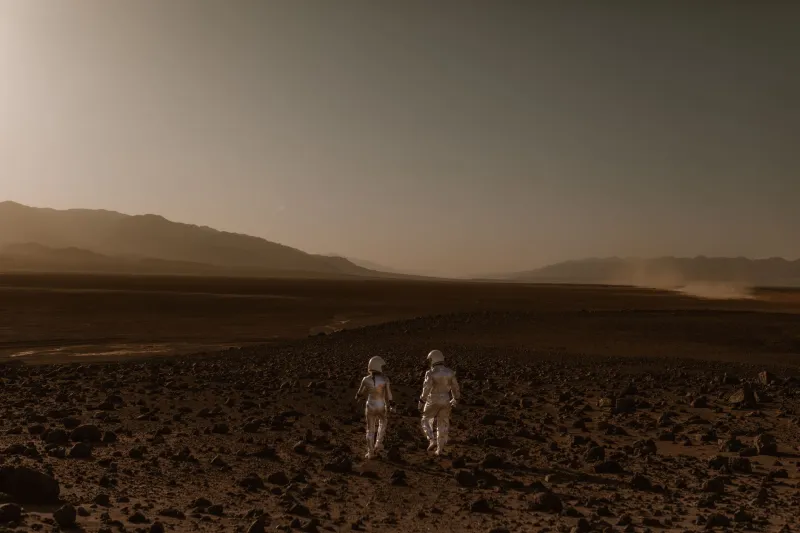
Obsessed With Mars? That Might Be Your Best Career Move Yet

Most people assume a passion for Mars is something you eventually grow out of — like collecting baseball cards or staying up past midnight to watch meteor showers with a flashlight and a star chart. But talk to enough engineers and scientists working at the cutting edge of aerospace, robotics, or data science, and a pattern starts to emerge. A surprising number of them will tell you, without a hint of embarrassment, that it all started with Mars.
Not a textbook. Not a classroom assignment. Mars.
The Unexpected Résumé Builder Hiding in Your Hobby
When Jenna Calloway landed her first job at a satellite communications startup in Austin, she didn't highlight her GPA on her cover letter. She talked about the years she'd spent as a teenager building a DIY telescope to track Mars during opposition, the online astronomy forums she moderated, and the detailed blog she'd kept about Martian weather patterns. Her hiring manager called it out specifically during the interview.
"He said it showed initiative, depth, and the ability to self-direct learning," she recalls. "It wasn't just that I liked space. It was that I'd done something with that interest over years."
This kind of story is more common than you'd think. The cultural moment around Mars exploration — driven by NASA's Perseverance rover, SpaceX's Starship ambitions, and a steady drumbeat of genuine scientific discovery — has created something unexpected: a talent pipeline. And employers in aerospace, defense, software, and even biotech are paying attention.
Why Mars Specifically Seems to Matter
You might wonder why Mars fandom translates to professional credibility in a way that, say, being really into Formula 1 racing or competitive gaming might not. The answer has a lot to do with what engaging seriously with Mars exploration actually requires.
To follow Mars science at even a casual level, you end up learning orbital mechanics, atmospheric chemistry, geology, robotics, and systems engineering — often without realizing it. You start caring about how long a signal takes to travel from Earth to Mars. You find yourself reading actual NASA mission reports. You argue with strangers online about whether perchlorate contamination makes Martian soil more or less hospitable to microbial life.
That's not passive fandom. That's active, self-directed learning across multiple STEM disciplines.
Dr. Marcus Osei, a planetary geologist at a research university in Colorado, puts it this way: "The students who come into my lab with a genuine Mars obsession already have a mental framework for thinking about planetary systems. They've been building that framework since middle school. I don't have to convince them why the work matters — they already know."
The Cultural Moment Is Creating Real Opportunity
The timing couldn't be better. The US aerospace sector is expanding faster than universities can produce graduates to fill it. NASA's Artemis program, the commercial space industry, and a growing number of defense contractors are all competing for the same pool of technically skilled workers. According to the Bureau of Labor Statistics, aerospace engineering jobs are projected to grow steadily through the end of the decade, with starting salaries that consistently outpace the national median for engineering roles.
But it's not just traditional aerospace. Data scientists who can handle massive telemetry datasets, materials engineers developing radiation-resistant composites, software developers building simulation environments — all of these roles are increasingly shaped by the demands of long-duration spaceflight. And companies like SpaceX, Blue Origin, Relativity Space, and dozens of smaller startups are explicitly hiring for mission-driven culture fit alongside technical skills.
In other words, caring about Mars isn't just a soft quality anymore. It's becoming a signal that employers use to identify candidates who think in systems, tolerate ambiguity, and stay motivated through long-horizon problems.
What Employers Are Actually Looking For
So what does "demonstrated Mars enthusiasm" actually look like on a résumé or in an interview? Career coaches working with STEM graduates say it shows up in a few consistent ways.
Self-directed projects. Building a model rover, programming a Mars weather simulator, contributing to citizen science projects through platforms like NASA's Science Activation program — these show initiative in a way that coursework alone can't replicate.
Community engagement. Running a local astronomy club, moderating a space-focused online community, or presenting at a science fair about Mars geology all demonstrate communication skills, which are chronically undervalued in early STEM career development.
Depth of knowledge. Being able to speak fluently about current missions, recent discoveries, or ongoing debates in planetary science signals that someone is genuinely plugged in — not just padding a bio.
None of this requires a trust fund or a PhD. It requires curiosity and follow-through, which, it turns out, are exactly what the industry is hungry for.
Starting Where You Are
If you're reading this on Marspedia, there's a decent chance you're already further along this path than you realize. Following Mars science closely, keeping up with mission updates, investing in gear that lets you observe and engage more deeply — these aren't just hobbies. They're building blocks.
For younger readers still figuring out their direction, the message is simple: don't let anyone convince you that your Mars obsession is a distraction from your future. For a lot of people, it is their future, and they just haven't connected those dots yet.
For adults already working in STEM who've let their space enthusiasm quietly fade into the background, it might be worth dusting it off. The cultural conversation around Mars is louder and more professionally relevant than it's ever been. Engaging with it — really engaging, not just liking posts — puts you in a network of curious, driven people who tend to build interesting things together.
The Long Game
Mars exploration is a decades-long project. The first crewed missions, whenever they happen, will be staffed by people who are probably in middle school or high school right now. The infrastructure supporting those missions — the software, the hardware, the policy frameworks, the medical research — is being built by people who are in college or early in their careers today.
Every generation that grows up with Mars as a living, ongoing story rather than a distant abstraction produces more people who want to work on that story. And the companies, agencies, and institutions trying to write the next chapter are actively looking for them.
So keep reading. Keep watching. Keep asking questions that don't have easy answers. The Red Planet has a funny way of pointing people toward exactly the right path.