Who Owns the Ice? The Coming Battle for Mars's Most Precious Resource
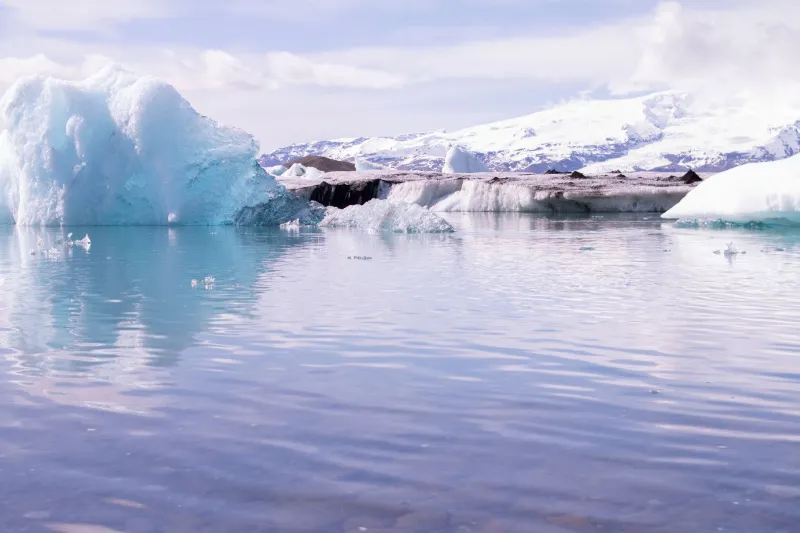
Imagine you've just touched down on Mars. After a seven-month journey, a cramped habitat, and more freeze-dried food than any human should ever have to eat, you step outside and you're standing on top of one of the most valuable things in the solar system: a massive deposit of subsurface water ice. Now imagine that three other flags are already planted nearby.
That scenario isn't science fiction — it's a policy problem we're actively failing to solve, and the clock is ticking.
Why Water on Mars Is Everything
Water isn't just for drinking. On Mars, ice is essentially a multi-tool survival kit. Split it into hydrogen and oxygen and you've got rocket propellant. Use the oxygen alone and you've got breathable air. Keep it liquid and you've got the backbone of any agricultural system capable of feeding a crew past the first supply drop from Earth.
Scientists have known for a while that Mars has water — lots of it. The polar ice caps are the obvious headline, but the more exciting stuff is hidden underground. Radar data from orbiters like the Mars Reconnaissance Orbiter and the European Space Agency's Mars Express have mapped massive subsurface ice deposits at mid-latitudes, some of them surprisingly close to the surface. NASA's own assessments suggest that certain regions near the 30th to 60th parallel could have ice sheets just a few feet down.
That's not a scientific curiosity. That's prime real estate.
The Outer Space Treaty Problem
Here's where things get legally messy. The 1967 Outer Space Treaty — the closest thing humanity has to a rulebook for space — says that no nation can claim sovereignty over the Moon, Mars, or any other celestial body. Sounds clear enough. But the treaty is almost completely silent on resource extraction.
The U.S. tried to fill that gap with the 2015 Commercial Space Launch Competitiveness Act, which gave American companies the legal right to own resources they extract from space, even if they can't own the territory itself. It's a clever workaround — think of it like fishing rights in international waters. You can't own the ocean, but you can own the fish you pull out of it.
Several other countries have since passed similar laws. Luxembourg, the UAE, Japan. But China, Russia, and much of the developing world haven't signed on to this interpretation, and they're not particularly happy about it. When the U.S. launched the Artemis Accords in 2020 — a set of bilateral agreements that include provisions for resource extraction — Russia's space agency dismissed them as an attempt by America to set the rules of a game it intends to win.
So right now, the legal framework for who gets to mine Martian ice is essentially: whoever gets there first, with a legal argument they hope nobody challenges hard enough.
Antarctica as a Test Case — And a Warning
Some space policy researchers point to the Antarctic Treaty System as a potential model for governing Mars. Signed in 1959, the Antarctic Treaty froze all territorial claims and designated the continent as a scientific preserve. No mining, no military activity, cooperative research only.
It's actually worked pretty well for Antarctica. Sixty-plus years in, the treaty is still holding. But there are some critical differences that make a direct copy-paste to Mars complicated.
First, Antarctica has no permanent human population and no economy. Nobody needs Antarctic water to survive. Mars would be different — settlers would be utterly dependent on local resources. Telling a colony they can't extract the ice beneath their feet isn't a scientific inconvenience; it's a death sentence.
Second, the Antarctic Treaty was negotiated before anyone had a serious commercial interest in the continent's resources. Mars is being approached in the opposite order — commercial players like SpaceX are already building hardware with specific extraction ambitions in mind, and the legal framework is scrambling to catch up.
Third, and maybe most importantly, Antarctica has no one living there who could be displaced or disadvantaged. Mars won't have indigenous populations either, but the power dynamics between early-arriving spacefaring nations and later-arriving ones could create a kind of resource colonialism that makes the whole enterprise politically toxic.
The Private Sector Wild Card
Governments are complicated, slow, and prone to negotiating for decades without resolution. Private companies are not. SpaceX has been pretty transparent about its ambitions: get to Mars, establish a self-sustaining city, make humanity multiplanetary. Elon Musk has specifically talked about Mars as a place where resources need to be utilized by the people who live there.
Blue Origin, various European and Asian aerospace startups, and a growing cluster of resource extraction-focused companies are all circling the same prize. The question isn't whether the private sector will attempt to claim Martian ice — it's whether any legal structure will exist to adjudicate competing claims when two companies show up at the same deposit.
Right now, the answer is: not really. The Artemis Accords establish "safety zones" around operations to prevent interference, but they don't create a binding arbitration system for resource disputes. And they definitely don't cover a scenario where a Chinese state mission and an American private company both want the same ice-rich crater.
What Needs to Happen Before We Get There
The honest answer is that the international community needs to get moving. The Moon is the testing ground — lunar ice at the south pole is already being eyed by NASA's Artemis program, and how those disputes get handled will set precedents that follow us all the way to Mars.
A few things that space policy researchers agree would help: a formal multilateral treaty specifically addressing resource extraction rights, ideally one that includes China and Russia; a neutral international body with actual authority to mediate disputes (not just issue strongly worded statements); and some kind of priority framework that balances first-mover investment incentives with equitable access for nations that get there later.
None of that is easy. All of it is necessary.
The Stakes Are Higher Than They Look
It's tempting to treat Martian water rights as a distant, theoretical problem — something for diplomats and lawyers to sort out in 2080. But the decisions being made right now, about which treaties the U.S. signs, which companies get government contracts, and which orbital platforms get built first, are already shaping who will have leverage when boots are on the ground.
The ice isn't going anywhere. But the window to establish fair, functional rules before the first shovel hits Martian permafrost is shorter than most people realize. And if we get this wrong, the first great conflict of the interplanetary age might not be fought with weapons — it might be fought over a water pump in a frozen crater 140 million miles from home.
That's a future worth paying attention to, starting now.