Greetings From Olympus Mons: A Mock Travel Brochure for the Solar System's Most Underrated Destination
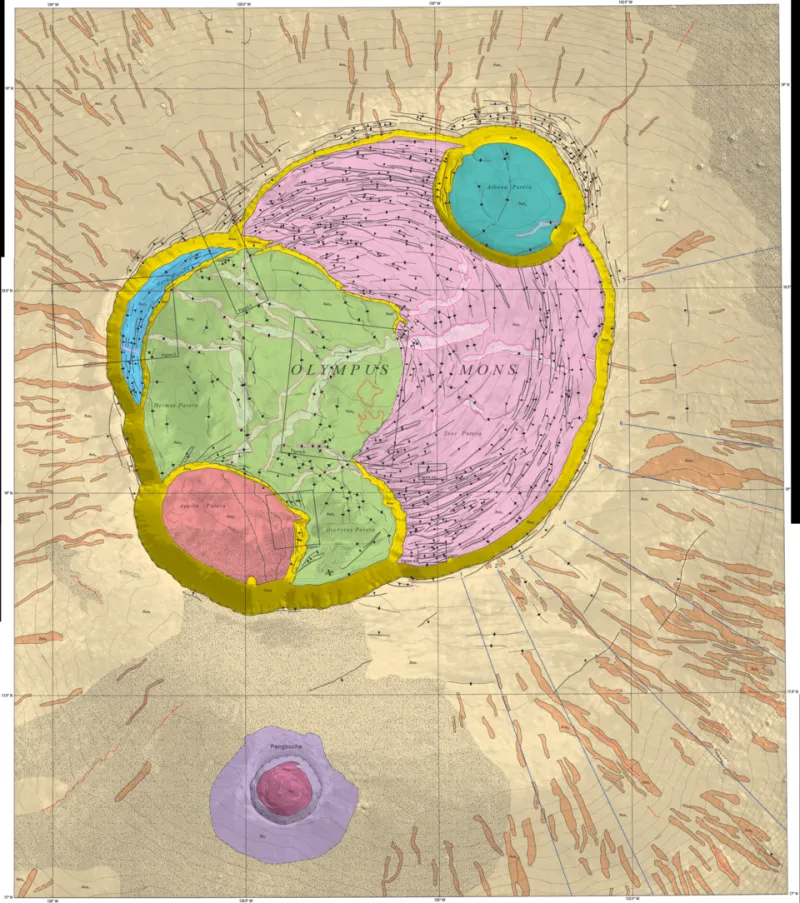
Photo: Peter J. Mouginis-Mark, Public domain, via Wikimedia Commons
The following has been lovingly fabricated by people who wish they could book the flight. All geography is real. All prices are speculative. All enthusiasm is genuine.
WELCOME TO MARS
Average high: -9°F. Average air pressure: less than 1% of Earth's. Average smile on arrival: enormous.
Whether you're a thrill-seeker, a geology buff, or just someone who's always wanted to watch a sunset from the top of the tallest mountain in the solar system, the Red Planet delivers. Let the Mars Tourism Board (est. someday) walk you through our premier destinations.
Olympus Mons: The View From the Top of Everything
Elevation: 13.6 miles — nearly three Everests stacked. Width: About the size of Arizona.
Olympus Mons is so wide and gently sloped that, standing on its summit, you couldn't see the edges. The base would hide below the horizon. Climbers, take note: the caldera complex at the top spans roughly 50 miles, and the sheer cliff ringing the base drops up to 6 miles.
Don't miss: The view of the Tharsis volcanoes lined up on the horizon — a skyline no other world can offer.
Souvenir pick: A topographic relief globe, because you'll want to point at where you stood.
Valles Marineris: The Grand Canyon's Older, Bigger Sibling
Length: Over 2,500 miles — it would stretch from New York to Los Angeles. Depth: Up to 4 miles.
If the Grand Canyon had a rivalry with a canyon ten times longer and deeper, Valles Marineris would win on every scorecard. Scientists believe tectonic forces cracked the crust as the Tharsis region swelled, and water may have flowed through parts of it billions of years ago.
Don't miss: Candor Chasma, where layered rock deposits hint at a wetter, moodier Martian past.
Souvenir pick: A framed USGS geologic map of the canyon system — the ultimate conversation-piece wall art.
The Polar Ice Caps: Two for the Price of One
Composition: Water ice, topped with seasonal dry ice (frozen CO2). Best season to visit: Northern summer, when the carbon dioxide frost sublimates away.
The north polar cap is one of the largest reservoirs of water ice off-Earth — which is exactly why mission planners keep circling it on their maps. Future explorers may drink it, breathe it, and fuel their ride home with it.
Don't miss: The spiral troughs carved into the ice, revealing hundreds of thousands of years of climate history in cross-section.
Souvenir pick: Ice-capped Mars globe with polar detail. Fitting.
Gale Crater and Jezero: Walk Where the Robots Walked
Claim to fame: Home to the Curiosity and Perseverance rovers, respectively.
Jezero's ancient river delta is the hottest ticket in planetary science — it's where Perseverance has been caching rock samples that a future mission may one day fly home to Earth. Standing on that delta would mean standing at the intersection of two worlds' histories.
Don't miss: The rover trails. Leave the tire tracks alone; they're historic now.
Souvenir pick: A certified Martian meteorite — the only Mars samples currently legal to own on Earth.
Hellas Basin: For the Depth-Obsessed
Diameter: About 1,400 miles. Depth: Five miles below the surrounding plains — the deepest point on Mars.
Formed by an ancient asteroid impact, Hellas is so deep that its floor has noticeably thicker air than the rest of the planet. Relatively speaking. You'd still want the suit.
Before You Book
A few honest disclosures from your tourism board: current travel time is six to nine months each way, radiation exposure remains a genuine engineering problem, and the return-trip fuel hasn't been manufactured on-site yet. The brochures of the future will handle these fine print items too.
But here's the real takeaway: everything described above is real. Olympus Mons, Valles Marineris, the polar caps — mapped, measured, and waiting. The travel industry of the next century is being sketched out right now in university labs and launch hangars across the United States.
Until boarding passes go on sale, the best way to bring Mars home is the analog way — globes, maps, meteorites, and a telescope pointed at that bright red star rising in the east.
Mars Tourism Board: Come for the thin air. Stay because, well, the return flight is complicated.