Microbes, Dust Storms, and Ancient Oceans: What Recent Mars Science Is Telling Us About Life
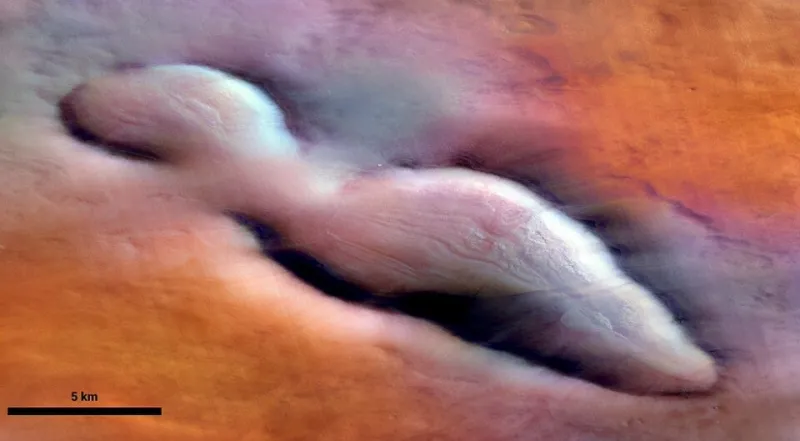
Photo: image:NASA/JPL-Caltech/UArizona - Mariagat1959 modified image by add color, Public domain, via Wikimedia Commons
For most of human history, Mars was just a reddish dot in the night sky — mysterious, distant, and mostly ignored except by astronomers and mythology enthusiasts. Today, we have six active spacecraft studying the planet from orbit and on the ground, and the data they're sending back is fundamentally reshaping how scientists think about life in the solar system. The big question — did life ever exist on Mars? — isn't answered yet. But we're closer than we've ever been, and the path there is more fascinating than most people realize.
Let's break down what recent missions have actually found, what it means, and why the answers coming out of Jezero Crater and beyond could be some of the most consequential in human history.
The Case for Ancient Mars as a Habitable World
First, some context. Modern Mars is brutal — average surface temperature around -80°F, atmospheric pressure less than 1% of Earth's, and radiation levels that would be dangerous to humans within minutes of unprotected exposure. But Mars wasn't always like this.
Geological evidence gathered by orbiters and rovers over the past two decades paints a picture of an early Mars that was dramatically different. Around 3 to 4 billion years ago, the planet likely had a thicker atmosphere, a magnetic field, and — critically — liquid water on its surface. River deltas, ancient shorelines, and mineral deposits that only form in the presence of water have all been identified. Jezero Crater, where Perseverance is currently operating, was once a lake roughly the size of Lake Tahoe.
That's not speculation. That's geology.
If life emerged on Earth during a similar period — and current evidence suggests it did — then ancient Mars had comparable conditions. The question isn't really whether Mars could have supported life. The question is whether it actually did.
What Perseverance Has Found — and Why It's a Big Deal
NASA's Perseverance rover, which landed in February 2021, was specifically designed to search for signs of ancient microbial life. It carries instruments capable of identifying organic compounds, analyzing rock chemistry, and most importantly, collecting and sealing rock core samples for eventual return to Earth.
Those samples are the real prize. Scientists have identified several cores from ancient lakebed sediments that contain organic molecules — the carbon-based building blocks associated with life as we know it. Now, organic molecules alone don't prove biology. They can form through non-biological chemistry too. But their presence in sedimentary rock that was once submerged under a lake? That's exactly where you'd expect to find biosignatures if microbial life existed.
The Mars Sample Return mission — a joint NASA and European Space Agency effort — is designed to bring those cores back to Earth where they can be analyzed with instruments far more powerful than anything that can be sent to Mars. The timeline for that mission has been complicated by budget pressures (a topic we've covered in depth here on Marspedia), but the scientific stakes couldn't be higher.
Dust Storms: An Unlikely Piece of the Life Puzzle
Here's something that doesn't get enough attention: Martian dust storms might actually be relevant to the life question, and not just as a hazard to solar-powered spacecraft.
Mars experiences regional and occasionally global dust storms that can blanket the entire planet for months. The 2018 storm that ended the Opportunity rover's mission is the most famous recent example. But researchers studying these storms have made an interesting observation — dust particles suspended in the Martian atmosphere interact with ultraviolet radiation in ways that generate hydrogen peroxide and other oxidizing chemicals.
This matters because these chemicals would make the surface even more hostile to organic preservation. However, it also means that any subsurface environment shielded from this chemistry becomes dramatically more interesting as a potential refuge for life. Organisms on Earth thrive in similarly extreme conditions — deep in Antarctic ice, inside volcanic vents, in highly acidic lakes. The emerging picture of Mars suggests that if life ever gained a foothold, it may have retreated underground as the surface became inhospitable.
The Methane Mystery
One of the most debated findings of the past decade involves methane. The Curiosity rover has repeatedly detected trace amounts of methane in the Martian atmosphere — and methane is interesting because on Earth, the vast majority of atmospheric methane is produced by biological activity (think cows, wetlands, landfills).
The catch? Mars Trace Gas Orbiter, a European spacecraft specifically designed to map atmospheric gases at high sensitivity, has not confirmed Curiosity's surface-level detections from orbit. Scientists are still working to reconcile this discrepancy. It could be an instrument artifact, localized geological outgassing, or something stranger. The honest answer is that we don't fully know yet — and that ambiguity is itself scientifically significant.
Where there's unresolved data, there's still a live investigation.
What This Means for Future Human Missions
The life question isn't just scientifically important — it has real implications for how we approach sending humans to Mars. If microbial life exists in the Martian subsurface today, we face a profound ethical and practical challenge: How do we explore Mars without contaminating it, and without bringing something back to Earth that we don't fully understand?
NASA's planetary protection policies exist precisely for this reason, and they're the subject of ongoing debate among scientists and policymakers. As the prospect of crewed Mars missions inches closer — whether through NASA's Artemis-era planning or SpaceX's long-term ambitions — these questions are moving from theoretical to urgent.
The decisions being made right now in Washington about Mars mission funding and international cooperation will directly shape whether we answer the life question in our lifetimes. That's not hyperbole. It's the practical reality of how science funding works.
Why This All Matters
Finding even a single microbial fossil in a Martian rock sample would be arguably the most significant scientific discovery in human history. It would mean that life is not a fluke — that given the right conditions, biology emerges. And if it happened twice in one solar system, the implications for a universe containing hundreds of billions of galaxies are staggering.
That's the weight behind every press release, every rover update, every blurry image of a rock formation that scientists spend weeks analyzing. Mars exploration isn't just about Mars. It's about understanding our place in a universe that may be far more alive than we imagined.
At Marspedia, we think staying connected to that story is worth your time — whether you're tracking mission updates, setting up a backyard telescope to catch Mars at opposition, or just geeking out over the latest findings. The Red Planet is telling us something. We're just learning how to listen.